National Park · HI
Hawaiʻi Volcanoes National Park
Hawaiʻi Volcanoes is quietest in May and October and busiest in December.
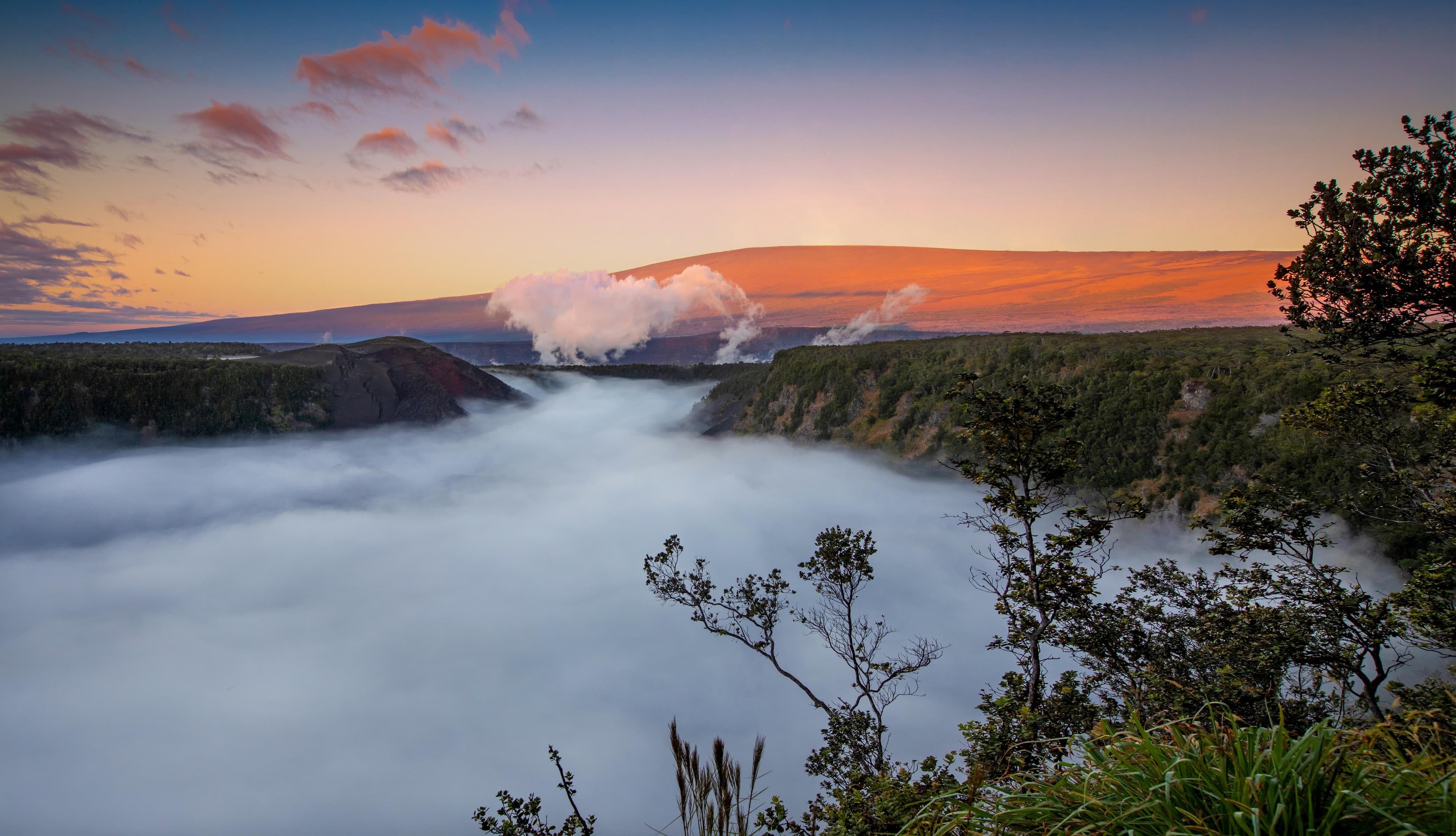
Hawai‘i Volcanoes National Park protects some of the most unique geological, biological, and cherished cultural landscapes in the world. Extending from sea level to 13,680 feet, the park encompasses the summits of two of the world's most active volcanoes - Kīlauea and Mauna Loa - and is a designated International Biosphere Reserve and UNESCO World Heritage Site.
1.6M recreation visits a year on average (2023–2025)
Data: NPS visitation 2023–2025 · crowd scores computed Oct 2026 · alerts checked Oct 18, 2026. How this is calculated →
Computed from federal data · Methodology by Sharon Ben-Moshe
Pick a month to visit Hawaiʻi Volcanoes
This week
7-day forecast
| Day | Conditions | High | Low | Precip chance |
|---|---|---|---|---|
| Sun 18 | Light drizzle | 71°F | 60°F | 35% |
| Mon 19 | Rain showers | 68°F | 60°F | 74% |
| Tue 20 | Rain showers | 67°F | 58°F | 74% |
| Wed 21 | Heavy drizzle | 69°F | 57°F | 76% |
| Thu 22 | Light drizzle | 70°F | 57°F | 76% |
| Fri 23 | Thunderstorm | 70°F | 60°F | 94% |
| Sat 24 | Drizzle | 73°F | 62°F | 98% |
Forecast data by Open-Meteo
Source: Open-Meteo
Weather
Monthly climate normals
| Month | Avg high | Avg low | Precip |
|---|---|---|---|
| January | 79°F | 65°F | 3.5" |
| February | 80°F | 65°F | 3.9" |
| March | 80°F | 66°F | 4.0" |
| April | 80°F | 67°F | 1.9" |
| May | 82°F | 68°F | 1.4" |
| June | 83°F | 70°F | 0.8" |
| July | 84°F | 70°F | 1.9" |
| August | 85°F | 71°F | 2.9" |
| September | 84°F | 70°F | 2.8" |
| October | 84°F | 70°F | 4.1" |
| November | 82°F | 69°F | 4.0" |
| December | 81°F | 67°F | 4.0" |
Source: NOAA 1991–2020 climate normals, SEA MTN 12.15, HI US
Know before you go
Fees & hours
- Entrance fee
- $30 — Private Vehicle Pass - The private vehicle pass admits the passholder and up to 14 passengers of a single, private (non-commercial) vehicle.
- Hours
- Hawai‘i Volcanoes National Park is open 7 days a week, 24 hours a day including holidays.
Source: NPS Data API
Conditions
Current alerts
- Caution
Protect Yourself from Volcanic Tephra
Volcanic ash, rock and glassy strands (tephra) is present at Kīlauea summit and can irritate your skin, eyes and respiratory system. For your safety, do not handle it. Eye protection, long sleeves, long pants, a hat, closed-toe shoes and a dust mask are recommended.
- Information
Upper Kahuku Road Closed Beyond Boot Decontamination Station
Upper Kahuku Road remains closed beyond the boot decontamination station due to storm damage. The Visitor Contact Station and most trails in the Kahuku Unit are now open following Hurricane Lala. Kahuku Road above the Lower Palm Trailhead is deeply rutted by the recent heavy rains. A 4WD is recommended to access areas above the Lower Palm Trailhead.
- Information
Sulphur Banks Bridge Closed; Boardwalk is Open
The Sulphur Banks Bridge is damaged and closed until further notice. The Haʻakulamanu area, boardwalk and Sulphur Banks Trail are open and accessible from the west side near Steam Vents.
- Caution
Kīpukapuaulu Trail Closed Due to Hazardous Trees and Hanging Limbs
Kīpukapuaulu Trail remains closed due to numerous hazardous trees and hanging limbs resulting from several recent storms. Managers are developing a plan and will reopen the trail when it is safe.
- Information
Hilina Pali Road Shoulder Work Scheduled 9/14/26 to 11/19/26
Hilina Pali Road beyond the Maunaiki Trailhead will be closed to motorized vehicles on September 14, 2026 from 6 a.m. to 4:30 p.m. Monday through Thursday for shoulder work. Hikers, bicyclists and backcountry permit holders will be given access but should expect delays while heavy machinery works on the road. The entire road will be open to all use outside of those hours including weekends and holidays. The work is expected to be complete by November 19, 2026.
- Information
Mauna Loa Road Closed Past First Cattle Guard for Tree Removal
Mauna Loa Road will be closed to all use from the first cattle guard to Mauna Loa Lookout for tree removal starting September 23 through October 29, 2026. The tree work will prepare the area for the Mauna Loa Road Rehabilitation Project. Vehicles, bicyclists and pedestrians will not be allowed during the closure.
- Information
Kīlauea eruption
Volcanic eruptions can be hazardous. Stay out of closed areas and monitor air quality. Eruptions can last a few hours and are often separated by pauses lasting several weeks.
Details on nps.gov →
Source: NPS Data API
FAQ
Hawaiʻi Volcanoes questions
When is the best time to visit Hawaiʻi Volcanoes?
Hawaiʻi Volcanoes is least crowded in May, October, and March. December is the busiest month, so visiting outside it means thinner crowds and easier parking.
How much does it cost to visit Hawaiʻi Volcanoes?
Entrance to Hawaiʻi Volcanoes costs $30 (Private Vehicle Pass - The private vehicle pass admits the passholder and up to 14 passengers of a single, private (non-commercial) vehicle.).
When is Hawaiʻi Volcanoes busiest?
Hawaiʻi Volcanoes is busiest in December, when crowds rate 10/10 (peak). Expect full parking lots and longer waits; arrive early or choose a quieter month.
How crowded is Hawaiʻi Volcanoes during holidays and fee-free days?
Holiday weekends (Memorial Day, Labor Day, Fourth of July) and official NPS fee-free days typically bring peak crowd conditions to Hawaiʻi Volcanoes. Arrive before 8 AM or after 3 PM to secure parking and avoid peak trail congestion.